F5CAB3시험자료100%시험패스인증공부
Wiki Article
그리고 PassTIP F5CAB3 시험 문제집의 전체 버전을 클라우드 저장소에서 다운로드할 수 있습니다: https://drive.google.com/open?id=14LJgR6OscWBfu14aXn_jvREK2MxxI1Nq
PassTIP 에서는 F5 F5CAB3 시험에 대비한 고품질 F5 F5CAB3덤프를 제공해 드립니다. F5 F5CAB3덤프는 IT 업계 종사자들에 있어서 아주 중요한 인증시험이자 인기 자격증을 취득할수 있는 필수과목입니다. F5 F5CAB3시험을 합격하여 자격증을 취득하시면 취업하는데 가산점이 될수 있고 급여 인상이나 이직에도 많을 도움을 드릴수 있습니다.
F5 F5CAB3 시험요강:
| 주제 | 소개 |
|---|---|
| 주제 1 |
|
| 주제 2 |
|
시험패스에 유효한 F5CAB3시험자료 인증시험
F5 F5CAB3 덤프는 고객님의F5 F5CAB3시험패스요망에 제일 가까운 시험대비자료입니다. 많은 자료정리 필요없이 PassTIP에서 제공해드리는 깔끔한F5 F5CAB3덤프만 있으면 자격증을 절반 취득한것과 같습니다. F5 F5CAB3 덤프를 다운받아 열공하세요.
최신 F5-CA F5CAB3 무료샘플문제 (Q41-Q46):
질문 # 41
A BIG-IP Administrator finds the following log entry after a report of user issues connecting to a virtual server:
01010201: Intercept exhaustion on 10.70.110.112 to 192.28.123.250:80 (proto 6) How should the BIG-IP Administrator modify the SNAT pool that is associated with the virtual server?
(Choose one answer)
- A. Increase the timeout of the SNAT addresses
- B. Remove the SNAT pool and apply SNAT Automap
- C. Add an IP address to the SNAT pool
- D. Remove an IP address from the SNAT pool
정답:C
설명:
The log message "Intercept exhaustion" indicates that the BIG-IP system has exhausted the available source port translations for one or more SNAT addresses. This occurs when too many concurrent client connections are being translated through a limited number of SNAT IP addresses, and all ephemeral source ports (typically ~64,000 per SNAT IP) are in use.
According to the BIG-IP Administration: Data Plane Configuration documentation:
Each SNAT IP address provides a finite number of available source ports.
When the number of concurrent connections exceeds the available port space, the BIG-IP logs an Intercept exhaustion error and new connections fail.
The recommended resolution is to increase the available SNAT resources by adding additional IP addresses to the SNAT pool.
Why the other options are incorrect:
A). Increase the timeout of the SNAT addressesIncreasing timeouts may actually worsen the problem by keeping ports allocated longer, accelerating port exhaustion.
B). Remove the SNAT pool and apply SNAT AutomapSNAT Automap uses the Self IP addresses on the egress VLAN, which may not provide additional capacity and can introduce routing or design issues. This is not a direct or recommended fix for SNAT exhaustion.
C). Remove an IP address from the SNAT poolThis would reduce the number of available source ports and further exacerbate the intercept exhaustion condition.
Correct Resolution:
By adding an IP address to the SNAT pool, the BIG-IP increases the total number of available source ports, alleviating intercept exhaustion and restoring successful client connections.
질문 # 42
Refer to the exhibit.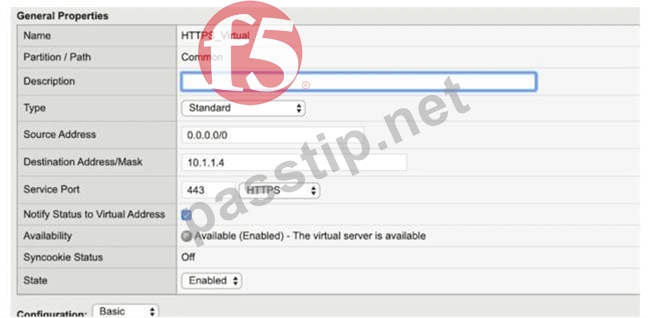
A BIG-IP Administrator configures a Virtual Server to handle HTTPS traffic. Users report that the application is NOT working. Which additional configuration is required to resolve this issue?
- A. Configure SSL Profile (Server)
- B. Configure SSL Profile (Client)
- C. Configure Service Port to HTTP
- D. Configure Protocol Profile (Server)
정답:B
설명:
According to the provided exhibit, the " SSL Profile (Client) " section in the Virtual Server configuration is empty. For a BIG-IP system to process HTTPS traffic, it must act as an SSL/TLS endpoint. This process, known as SSL Termination or SSL Offload, requires the assignment of a Client SSL Profile to the Virtual Server. Without this profile, the BIG-IP does not have the necessary certificate and private key information to perform the SSL handshake with the client ' s browser. Consequently, when a user attempts to connect via HTTPS, the TCP connection may establish, but the SSL handshake will fail because the BIG-IP will not know how to decrypt the incoming encrypted packets.
A Client SSL profile defines the ciphers, certificates, and keys that the BIG-IP uses to communicate securely with the client. In a standard HTTPS deployment, the BIG-IP decrypts the traffic and can then send it to the backend pool members either as plain text (header insertion/manipulation) or re-encrypt it using a Server SSL profile. While a Server SSL profile (Option C) is needed if the backend servers themselves require HTTPS, the initial failure for a user reaching a Virtual Server is almost always the lack of a Client SSL profile to terminate the user ' s connection. Changing the Service Port to HTTP (Option D) would be incorrect because the goal is to handle HTTPS traffic (typically port 443). Assigning the " clientssl " or a custom client-side profile from the " Available " list to the " Selected " list in the GUI is the mandatory step to make the Virtual Server operational for secure web traffic.
질문 # 43
During high-demand traffic events, the BIG-IP Administrator needs to limit new connections per second.
What should be applied?
- A. Connection rate limit
- B. Connection limit
- C. OneConnect profile
- D. HTTP Compression profile
정답:A
설명:
Connection rate limiting controls how many new connections per second are accepted, protecting backend resources.
질문 # 44
The BIG-IP Administrator has configured an HTTP health monitor applied to a Pool of HTTP web servers hosting www.f5.com, but all Pool Members show a DOWN status. The web server is returning a response of '
400 Bad Request ' . What would be the correct monitor Send string?
- A. GET /healthmonitor.html HTTP/1.1 Connection: Close
- B. GET /healthmonitor.html HTTP/1.1 Connection: Close
- C. GET /healthmonitor.html HTTP/1.1 Host: www.f5.com Connection: Close
- D. GET /healthmonitor.html HTTP/1.1 Connection: Close
정답:C
설명:
A 400 Bad Request response from an HTTP/1.1 web server is a definitive indicator that the HTTP request sent by the health monitor is missing a required Host header . In HTTP/1.1, the Host header is mandatory per RFC 7230. Web servers - particularly those hosting named virtual hosts such as www.f5.com - will reject any HTTP/1.1 request that omits the Host header, returning a 400 error, which the BIG-IP monitor interprets as a failed health check, marking all members DOWN.
The correct Send string must include:
* The GET request line with HTTP/1.1 protocol declaration
* A
(carriage return + line feed) after the request line
* The Host: www.f5.com header to satisfy HTTP/1.1 requirements
* A
after the Host header
* Connection: Close header to instruct the server to close the connection after responding
* A final
to properly terminate the HTTP request headers
Only option C satisfies all these requirements with the correct syntax and Host header inclusion.
Option D (the current configured string) omits the Host header entirely - the root cause of the 400 error.
Options A and B are structurally incomplete or syntactically malformed.
Reference: BIG-IP Administration - Data Plane Configuration, Module: Health Monitors - HTTP Monitor Send String Configuration and HTTP/1.1 Host Header Requirements.
질문 # 45
An LTM device has a virtual server mapped to www.f5.com with a pool assigned. The objects are defined as follows: Virtual server: Destination 192.168.245.100:443 netmask 255.255.255.0. Persistence: Source address persistence netmask 255.0.0.0. SNAT: Automap. Profiles: HTTP/TCP. How should the BIG-IP Administrator modify the persistence profile so that each unique IP address creates a persistence record?
- A. netmask 255.255.255.0
- B. netmask 255.255.255.255
- C. netmask 255.255.0.0
- D. netmask 0.0.0.0
정답:B
설명:
Source Address Affinity (Persistence) works by tracking the source IP address of incoming packets to ensure a client stays connected to the same backend server. The " netmask " setting within the persistence profile determines the " granularity " of this tracking. A netmask tells the BIG-IP how many bits of the source IP address to ignore when creating the persistence record. For example, the current setting of 255.0.0.0 (a /8 mask) means the BIG-IP only looks at the first octet of the IP; this results in all users from the same large Class A network (e.g., everyone from 10.0.0.0 to 10.255.255.255) being persisted to the exact same server, which can lead to severe load imbalance.
To ensure that each unique IP address creates its own individual persistence record, the administrator must set the netmask to 255.255.255.255 (for IPv4). This is a " host mask " or /32, which instructs the BIG-IP to evaluate all 32 bits of the client ' s source IP address. With this setting, 10.1.1.1 and 10.1.1.2 will be treated as distinct entities and can be load balanced to different servers, each maintaining their own " stickiness " .
While Option A (255.255.255.0) would group users by their local subnet, only the full 255.255.255.255 mask satisfies the requirement for true unique-IP persistence. This configuration is standard for internet-facing applications where users arrive from diverse locations and the administrator wants to maintain the most granular and balanced distribution of traffic possible.
질문 # 46
......
PassTIP는 다른 회사들이 이루지 못한 PassTIP만의 매우 특별한 이점을 가지고 있습니다.PassTIP의F5 F5CAB3덤프는 전문적인 엔지니어들의F5 F5CAB3시험을 분석이후에 선택이 된 문제들이고 적지만 매우 가치 있는 질문과 답변들로 되어있는 학습가이드입니다.고객들은 단지 PassTIP에서 제공해드리는F5 F5CAB3덤프의 질문과 답변들을 이해하고 마스터하면 첫 시험에서 고득점으로 합격을 할 것입니다.
F5CAB3완벽한 덤프공부자료: https://www.passtip.net/F5CAB3-pass-exam.html
- F5CAB3높은 통과율 덤프데모문제 ✌ F5CAB3시험응시 ???? F5CAB3시험대비 덤프샘플 다운 ???? ➡ www.exampassdump.com ️⬅️에서➡ F5CAB3 ️⬅️를 검색하고 무료 다운로드 받기F5CAB3시험패스 가능한 인증덤프자료
- F5CAB3시험대비 ???? F5CAB3시험대비 ???? F5CAB3시험패스 가능한 인증덤프자료 ???? ➽ www.itdumpskr.com ????은▶ F5CAB3 ◀무료 다운로드를 받을 수 있는 최고의 사이트입니다F5CAB3퍼펙트 최신버전 덤프
- F5CAB3완벽한 시험덤프공부 ???? F5CAB3완벽한 시험덤프공부 ???? F5CAB3시험대비 덤프샘플 다운 ???? ✔ www.koreadumps.com ️✔️웹사이트에서▷ F5CAB3 ◁를 열고 검색하여 무료 다운로드F5CAB3시험유효덤프
- 시험대비 F5CAB3시험자료 덤프공부 ???? ⏩ www.itdumpskr.com ⏪을(를) 열고▷ F5CAB3 ◁를 입력하고 무료 다운로드를 받으십시오F5CAB3최신 업데이트 인증공부자료
- F5CAB3시험자료 최신 시험 기출문제 모음 자료 ???? ➥ www.exampassdump.com ????을(를) 열고{ F5CAB3 }를 입력하고 무료 다운로드를 받으십시오F5CAB3참고자료
- F5CAB3시험자료 인기자격증 시험덤프데모 ???? 「 F5CAB3 」를 무료로 다운로드하려면⮆ www.itdumpskr.com ⮄웹사이트를 입력하세요F5CAB3최신 업데이트 인증공부자료
- F5CAB3시험자료 최신 시험 기출문제 모음 자료 ???? “ www.passtip.net ”웹사이트를 열고{ F5CAB3 }를 검색하여 무료 다운로드F5CAB3시험대비 덤프샘플 다운
- 시험패스에 유효한 F5CAB3시험자료 덤프로 시험패스하기 ???? 오픈 웹 사이트【 www.itdumpskr.com 】검색☀ F5CAB3 ️☀️무료 다운로드F5CAB3시험패스 가능한 공부하기
- F5CAB3완벽한 시험덤프공부 ???? F5CAB3퍼펙트 덤프 최신 데모 ???? F5CAB3최신덤프자료 ???? 《 www.koreadumps.com 》에서{ F5CAB3 }를 검색하고 무료로 다운로드하세요F5CAB3완벽한 시험덤프공부
- F5CAB3시험자료 인기자격증 시험덤프데모 ???? ➤ www.itdumpskr.com ⮘에서⮆ F5CAB3 ⮄를 검색하고 무료 다운로드 받기F5CAB3참고자료
- F5CAB3시험자료최신버전 인증덤프 ???? 오픈 웹 사이트( www.pass4test.net )검색➽ F5CAB3 ????무료 다운로드F5CAB3시험대비 덤프샘플 다운
- bookmarkspedia.com, gatherbookmarks.com, nimmansocial.com, jakubevwr142853.iamthewiki.com, pennyfesk129427.blogthisbiz.com, rishiqwyk222300.buyoutblog.com, elijahjyzo828346.wikifrontier.com, kiarafbij440657.blogchaat.com, albertzxmv654528.blogitright.com, nikolaslwwv976307.verybigblog.com, Disposable vapes
BONUS!!! PassTIP F5CAB3 시험 문제집 전체 버전을 무료로 다운로드하세요: https://drive.google.com/open?id=14LJgR6OscWBfu14aXn_jvREK2MxxI1Nq
Report this wiki page